€25.88 – €32.88Preisspanne: €25.88 bis €32.88
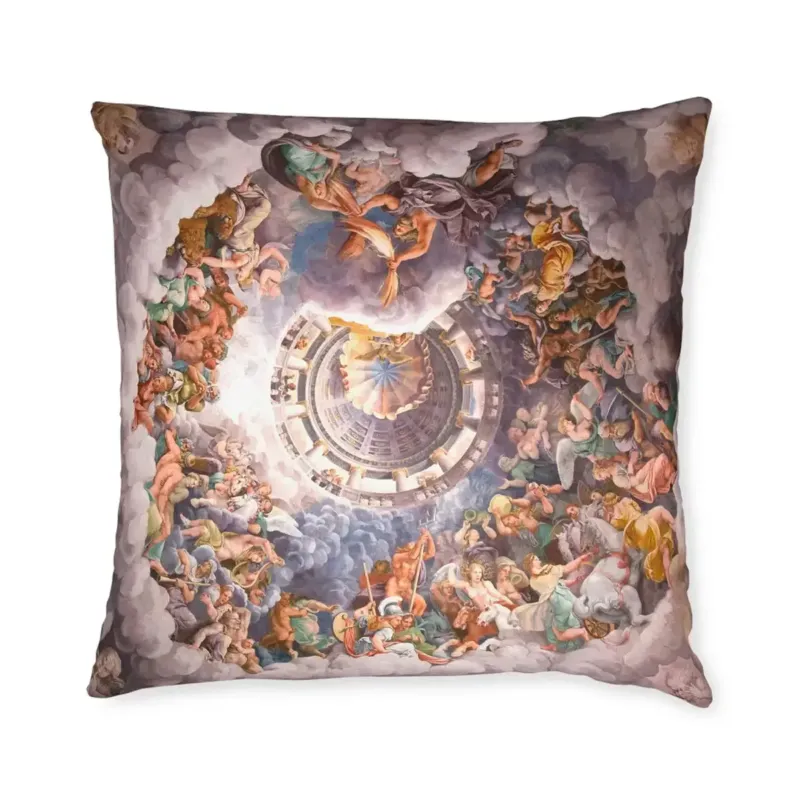
Bring one of the most immersive fresco environments of the Italian Renaissance into your interior with our Chamber of the Giants art pillow by Giulio Romano. This decorative pillow translates the dramatic illusionism of Palazzo del Te into a functional design object, combining mythological storytelling, architectural mastery, and historical depth.
Art movement: Mannerism (Late Italian Renaissance)
The Chamber of the Giants (Sala dei Giganti, 1532–1535) is a monumental fresco cycle created by Giulio Romano for the Palazzo del Te in Mantua. The room depicts the mythological battle between the Olympian gods and the Giants, who attempted to overthrow Jupiter and storm Mount Olympus.
The fresco covers the walls and ceiling as a single, continuous scene. Architectural boundaries dissolve as painted columns, cornices, and massive stone blocks appear to collapse inward. Giants are crushed beneath falling structures, their bodies twisted in violent motion, while Jupiter’s thunderbolts strike from above. The illusion is total: the viewer is placed inside the catastrophe, surrounded by tumbling forms and shattered architecture.
This radical approach abandons the balanced harmony of the High Renaissance in favor of movement, distortion, and theatrical intensity. The work stands as one of the most extreme and influential examples of Mannerist illusionism.
Giulio Romano (1499–1546) was an Italian painter and architect and one of the leading figures of Mannerism. A pupil of Raphael, he developed a highly original style that exaggerated proportion, perspective, and spatial logic.
At Palazzo del Te, Romano pushed fresco painting beyond decorative narrative, transforming entire rooms into immersive visual experiences. His work marked a decisive shift from Renaissance balance toward dramatic experimentation and influenced later developments in Baroque spatial illusion.
This pillow works especially well in living rooms, studies, libraries, and interiors inspired by classical or architectural themes. Its intense visual energy makes it a strong focal point, best paired with neutral walls, stone textures, or minimalist furniture.
The design suits spaces that value art history, mythological narratives, and architectural experimentation.
Machine wash on a gentle cycle. Avoid high heat when drying. Proper care helps preserve fine detail, contrast, and color depth over time.